Choosing Your First Instrument: A GUIDE FOR BEGINNERS

Choosing your first instrument means balancing how quickly you’ll make progress with practical constraints like cost, space, and physical fit; this guide simplifies that decision so you can start playing sooner and stay motivated.
You will learn which instruments typically give fast wins, how portability and budget shape realistic options, and which choices fit different ages and musical goals. The article defines clear criteria—ease of learning, typical beginner cost, portability, and noise level—and uses side-by-side comparisons and compact decision tools to turn those criteria into action. Readers will find quick milestones to expect, age- and goal-based recommendations, and practical next steps such as renting, trying lessons, and what to test before buying.
Throughout, related concepts like frets, keys, drum pads, and weighted action are explained so you understand the parts that matter. The structure that follows covers easiest instruments, age-and-goal matching, decision factors, and direct comparisons between popular variants so you can choose with confidence.
What Are the Easiest Instruments to Learn for Beginners?
Guitar/Bass Lessons - Click here to learn more about guitar and bass lessons!
Piano LESSONS - CLICK HERE TO LEARN MORE ABOUT PIANO LESSONS!
Singing/Voice LESSONS - CLICK HERE TO LEARN MORE ABOUT SINGING AND VOICE LESSONS!
Drum LESSONS - CLICK HERE TO LEARN MORE ABOUT DRUM LESSONS!
Which Instruments Offer Quick Learning and Early Success?
Quick-learning instruments let learners play recognizable songs within a few practice sessions by focusing on a small, repeatable skill set. The ukulele and recorder are classic examples because they reduce fretting complexity and emphasize open, repeatable patterns that map directly to popular songs. Digital keyboards show notes visually and enable simple two-hand chords without complicated fingering, while harmonicas and basic percussion let learners join ensembles with minimal setup. Early milestones often include strumming three chords cleanly, playing a simple melody, or maintaining a steady beat for a full song, which build confidence and momentum.
Play a three-chord song with steady timing.
Finger a simple melody on keyboard or recorder.
Keep a consistent 4/4 rhythm on a practice pad or basic drum kit.
Tune and change strings or reeds as basic maintenance.
These milestones guide practice sessions and help learners track progress toward performing simple pieces.
How Do Portability and Affordability Affect Beginner Instrument Choices?
Portability and cost determine how easily you can practice and where you can play, which directly impacts long-term commitment to an instrument. Lightweight, low-cost instruments reduce the friction of daily practice and make it simpler to take lessons, join groups, or rehearse while traveling.
Renting or buying used starter instruments can cut initial costs and allow learners to test interest before investing in higher-quality gear. For noisy or space-consuming instruments, options like silent practice modes, headphones for digital pianos, or practice pads for drums let apartment dwellers practice without friction.
Rent a mid-range instrument to test commitment before buying.
Choose a digital or compact variant (digital piano, travel ukulele) for apartments.
Buy a good-quality used instrument to balance price with playability.
These strategies make beginning more accessible and preserve budget for lessons and essential accessories.
How Do You Choose the Right Musical Instrument for Your Age and Goals?
Choosing by age and goals aligns physical ability and musical aspirations to the right instrument, reducing frustration and improving enjoyment. Age affects reach, hand size, and breath control, while goals—such as joining a band, composing, or solo performance—determine whether you need amplified instruments, weighted action, or a strong melodic foundation. Assessing both dimensions narrows choices quickly and creates a clearer learning path with appropriate milestones and gear choices.
For young children: small-bodied instruments (3/4 violins, soprano recorder, small ukuleles) for comfortable ergonomics.
For teens: guitar or keyboard if joining bands; wind instruments if orchestral paths are desired.
For adults and seniors: piano/keyboard for low-impact coordination, ukulele for quick gratification, and percussion for rhythm-driven hobbies.
These recommendations allow learners to choose instruments that respect physical constraints and align with social or creative goals, enabling faster progress and sustained motivation.
What Instruments Are Best for Kids, Adults, and Seniors?
Age-specific picks focus on ergonomics and learning style to keep practice rewarding and safe. Kids benefit from scaled instruments and games that build coordination, while adults often prefer instruments with direct routes to repertoire such as guitar or keyboard. Seniors should prioritize low physical strain and clear progress markers; digital keyboards with adjustable benches and simple chordal progressions work well. Adapting lesson plans and instrument size to the learner increases enjoyment and reduces early drop-off.
Practical size and setup tips include sizing instruments to reach and using lightweight straps or stands to manage posture and comfort for longer practice sessions.
How Do Musical Goals and Preferred Genres Influence Your Instrument Choice?
Your musical goals anchor technical priorities: band-oriented players need amplification and rhythm skills, classical aspirants need technical control and acoustically faithful instruments, while songwriters often choose guitar or piano for harmonic support. Genre maps help—folk and pop map to acoustic guitar or ukulele, rock and jazz often favor electric guitar or full drum kits, and electronic music leans toward synths and MIDI keyboards. Defining short- and long-term goals clarifies which instrument variants and accessories are worth the investment.
A quick genre-to-instrument mapping helps focus choices and the required practice pathways.
What Factors Should You Consider When Picking Your First Instrument?
Selecting an instrument requires assessing budget, space, physical attributes, noise, and access to lessons; each factor changes acceptable options and influences practice consistency. Budget includes initial cost and recurring expenses such as lessons and maintenance. Space and noise constraints determine whether a digital or muted solution is necessary. Physical attributes like hand size or breath capacity suggest certain families or scaled instruments. Considering practice environment and motivation is critical to sustaining progress.
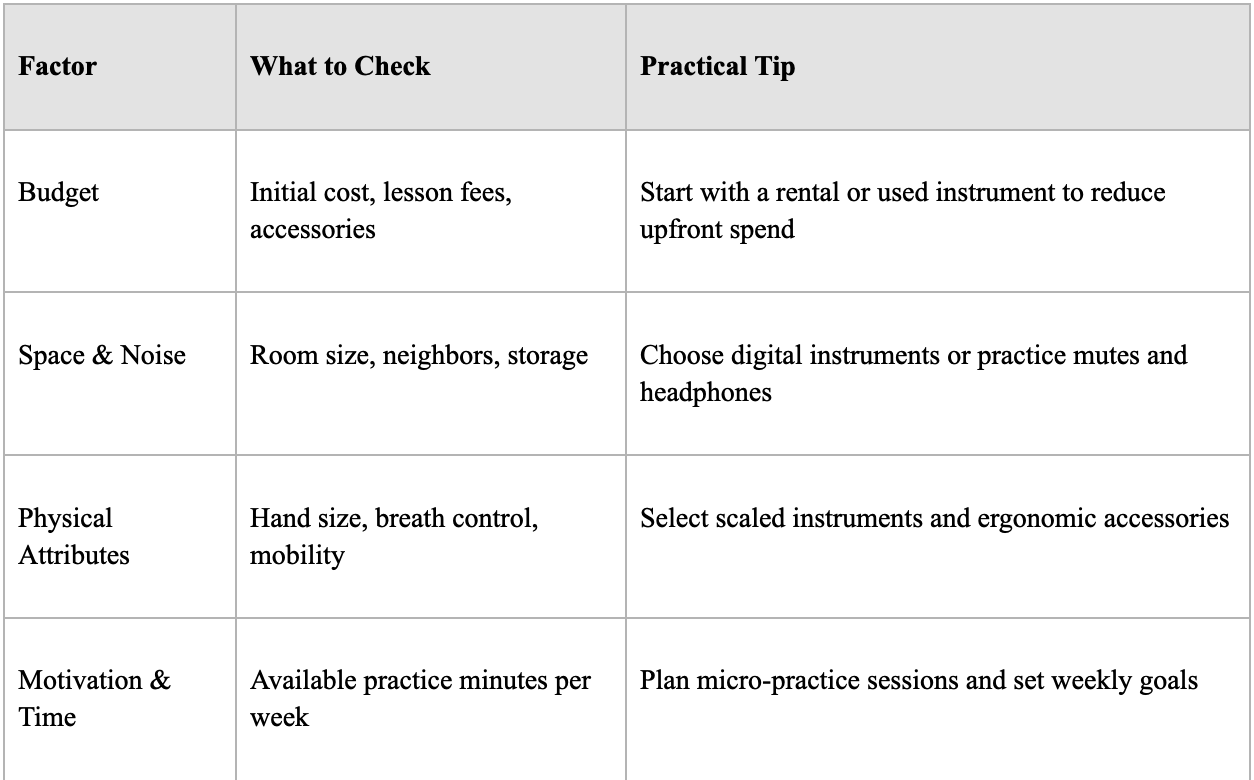
These practical pairings help you choose an instrument that fits daily life, increasing the chance you’ll keep playing.
How Do Budget, Space, and Physical Attributes Impact Your Choice?
Budget limits affect whether you buy new, used, or rent, and whether you can afford lessons that accelerate progress. Space and noise determine if you need silent practice options like headphones for digital pianos or practice pads for drummers. Physical attributes such as hand span or lung capacity steer you to scaled instruments or winds with easier embouchure demands. Combining these constraints with your goals yields a realistic shortlist of instruments to try in person.
Actionable steps include testing scaled models, using headphones for early practice, and planning a modest accessory budget for tuners, straps, and maintenance.
Why Is Considering Practice Environment and Motivation Important?
A supportive practice environment and realistic motivation plan turn curiosity into skill by reducing barriers and reinforcing consistency. Scheduled short sessions, focused goals, and accountability—through teachers, groups, or apps—drive steady improvement. Creating a comfortable practice space, minimizing noise conflicts, and setting incremental milestones maintain enthusiasm and skill growth. Regular, achievable targets also make instrument decisions feel reversible and low-risk, encouraging experimentation.
Start with micro-practice sessions of 10–20 minutes, set a weekly goal, and reassess instrument fit after a month to ensure continued alignment.
How Can You Compare Popular Beginner Instruments to Make the Best Choice?
Comparing variants—acoustic vs electric guitar and digital vs acoustic piano—requires looking at playability, maintenance, amplification needs, and genre fit so you buy what supports your goals. Side-by-side comparisons illuminate trade-offs like string tension, action, and the need for amps or pedals versus the convenience of portability and headphone practice. Use succinct criteria—cost to start, typical maintenance, space needs, and sound control—to choose the variant that reduces practice friction and aligns with your musical direction.
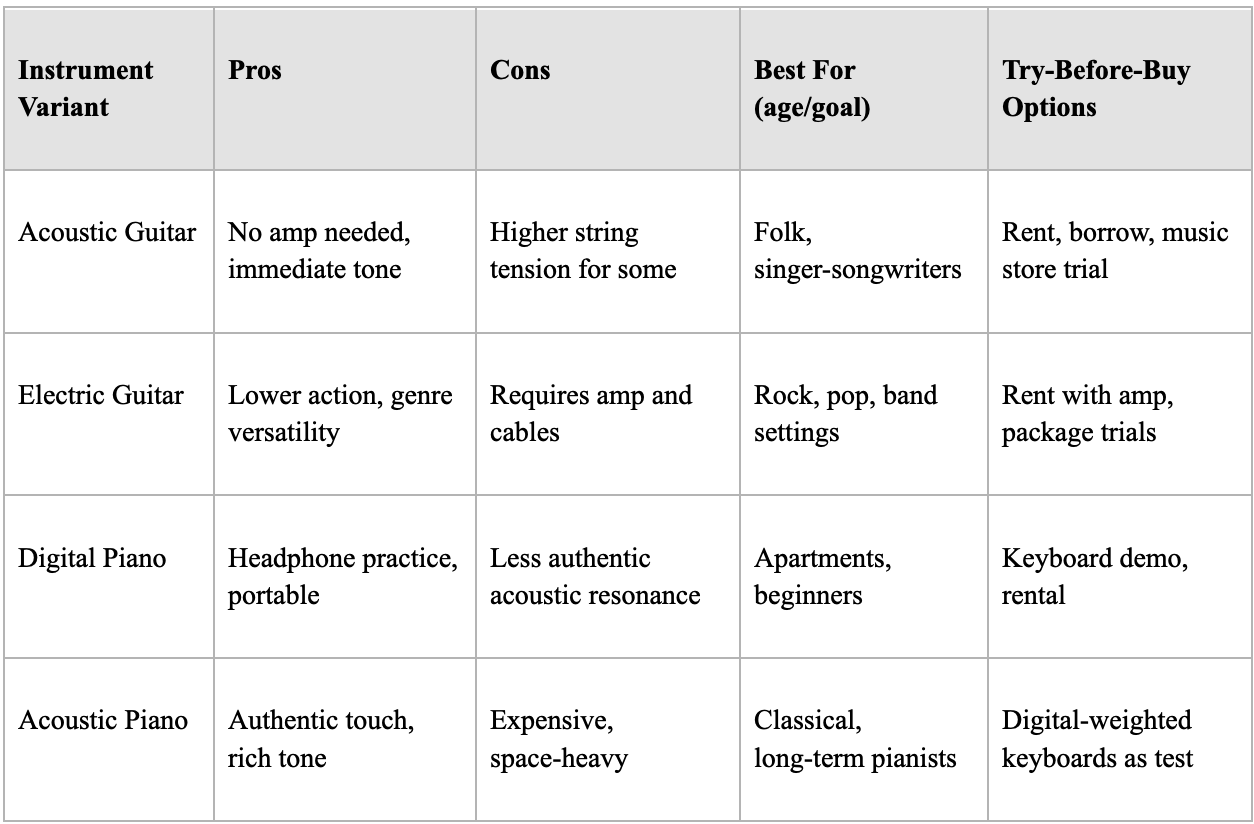
Use these comparisons to match functional needs to real-world constraints and priorities.
What Are the Differences Between Acoustic and Electric Guitars?
Acoustic and electric guitars differ in string tension, body resonance, and amplification needs, which affect initial playability and the sound palette available to learners. Electric guitars often have lower string action and are easier on fingers, while acoustics produce full tone without electronics. Amplification for electrics adds cost and setup but opens pedals and effects that shape practice goals. Maintenance differs too—acoustics need attention to humidity and action, while electrics require amp care and cable management.
Try both variants briefly to feel action and tone; many beginners find electric setups more forgiving physically but acoustics more immediately rewarding for unplugged performance.
How Do Digital and Acoustic Pianos Compare for Beginners?
Digital pianos with weighted keys emulate the feel of acoustic instruments while offering headphone practice and MIDI features that support learning apps and recording. Acoustic pianos provide superior tone and dynamic nuance but require space, tuning, and higher cost. For apartment living or limited budgets, a quality digital piano with weighted action balances skill transfer and practical constraints. Consider touch sensitivity and key weight if you plan to transition to acoustic repertoire later.
For rhythm-focused beginners curious about percussion, short-term lessons are an efficient way to try the family of drum and percussion instruments; local music educators and lesson packages can help you test rhythm skills before committing to a kit. Georgetown Drum Sessions offers structured drum lesson packages designed to introduce rhythm basics and practice pathways for beginners, which can be useful for learners who want guided trial before buying gear.
This guide gives you actionable comparisons, simple tests to try in person, and practical next steps so you can choose an instrument that fits your life and keeps you playing.