🥁 Should I get Drum Lessons for My kids?
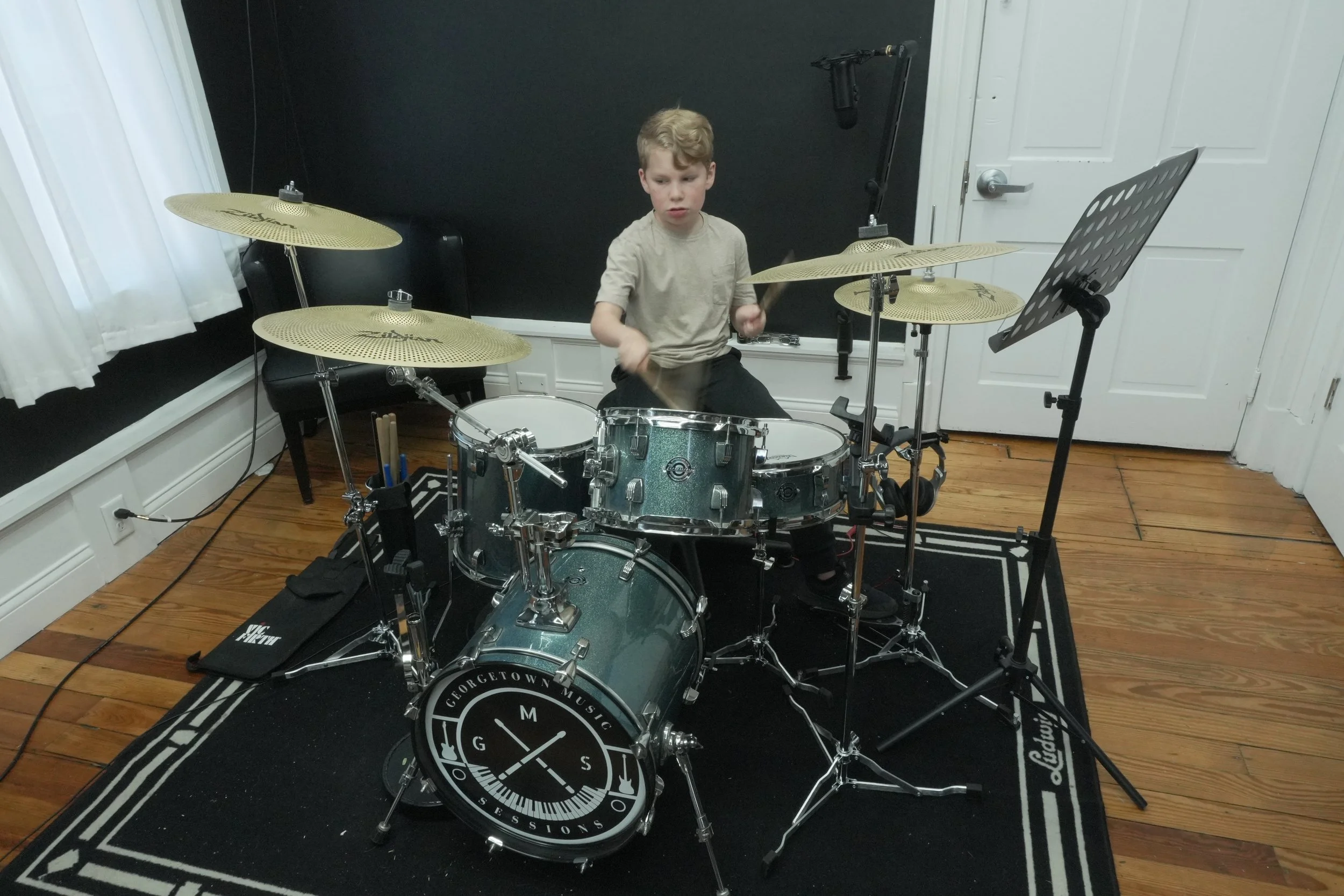
Here at Georgetown Music Sessions, we’re all about the vibe. Whether you’re a guitar player trying to nail that perfect blues bend, a singer looking for better breath control, or a drummer trying to find the pocket on a tricky fusion tune, it all starts with one thing: passion.
When I look at the musicians we teach—from the seven-year-olds tapping away on the practice pad to the adults finally picking up the guitar they always wanted to play—that fire is the common thread. It’s what gets you through the tough days when your hands feel clumsy or when a new theory concept just won't click.
For us, passion isn’t just a nice-to-have; it’s the fuel. It's the engine that drives consistency, and as any experienced musician will tell you, consistency is the real secret to getting good.
The Drummer's Uniqueness: Energy and Momentum
I’ve been a professional drummer for a long time, and I’ve taught a lot of students across all the instruments we offer. And while every instrument demands dedication, there’s something unique about the energy of a prospective drummer.
When a student comes in and they just want to hit things, or they can’t stop tapping their foot and hands to the rhythm in their head—that’s not just noise, man. That’s pure, untapped musical drive. You could call it excitement, or boundless energy, but I see it as passion in its embryonic stage. It’s raw, ready to be shaped, and incredibly powerful.
My Own Path: Starting Late and the Missing Spark
I often think about my own journey. I didn't actually start really shedding on the kit until I was about 13 years old. Now, don’t get me wrong, I dug music, and I eventually caught up. I put in the hours, I went to music school, and I learned my rudiments inside and out. But sometimes, I feel like I missed that initial, uninhibited burst of natural rhythmic energy that you see in a kid who starts younger.
When you’re 13, you’re already in your head a bit more. You’re more self-conscious. You worry about what people think. That can be a great motivator for practice, sure, but it can also be a little barrier to just letting loose and exploring sound without judgment.
The younger kids—the 7 to 10-year-olds—they just go for it. They are in the moment. That lack of inhibition is a huge advantage in music, especially in finding your natural pocket and developing a unique feel. They’re less likely to overthink the theory and more likely to just feel the pulse.
Why Earlier is Often Better (The 7 to 10 Year Window)
This brings me to my number one piece of advice for parents: If you see that drive, that constant tapping, that fascination with music videos or live shows—get them started early.
We find that the 7 to 10 year old window is a real sweet spot for formal music education:
1. Developing Fine Motor Skills and Coordination
Drums, in particular, require a unique kind of four-way coordination. Think about it: one hand keeps the snare beat, the other hand rides the cymbal, one foot hits the kick drum, and the other foot controls the hi-hat. It’s like doing four different dances simultaneously!
Starting younger allows the brain to integrate these complex movements into muscle memory before the body goes through major growth spurts. They establish those foundational neural pathways for rhythmic independence much more easily. We start them slow, focusing on just the basic stroke mechanics and then slowly build up to full kit coordination. It’s all about building a sturdy foundation.
2. Theory without the Theory Hang-up
When a kid learns music theory—even just basic rhythm concepts like quarter notes and eighth notes—at a young age, it's absorbed more naturally. They don't see it as a dry, academic subject; they see it as the language of the fun thing they are doing.
We teach theory through the instrument. For example, instead of explaining the mathematical division of a measure, we show them how a whole note feels compared to an eighth note. They learn to read sheet music not because they have to, but because it unlocks cool new rhythms they can play on the kit. It's practical application first, formal explanation second.
3. Consistency and Routine
Music, like any skill worth having, requires consistent practice, or shedding. Establishing a practice routine early—even just 15-20 minutes a day, four times a week—teaches a child discipline and delayed gratification. They learn that the payoff for the work they put in today is being able to play that awesome fill next week. This lesson isn’t just for music; it’s a life skill.
This isn't just about drums, of course. This philosophy applies to all the instruments we teach:
Guitar: Getting those tiny fingertips used to the pressure of fretting chords before the hands get huge makes a big difference.
Piano: Developing hand independence and learning to read the grand staff (bass and treble clefs) is easier when the brain is highly plastic.
Voice/Singing: Establishing proper breath support and ear training early on prevents bad habits from taking hold later.
It’s Not About Forcing a Career
Look, I’m not saying you need to start planning their stadium tour. That’s not the point. The point of early music lessons is about unlocking a true, lifelong passion for music—and giving them an outlet for expression that goes way beyond words.
Even if they don't become a professional musician, they will carry that musicality with them:
Better Focus: Consistent practice improves concentration.
Problem Solving: Breaking down a complex piece or rhythm teaches them how to approach big problems step-by-step.
Confidence: Performing a song, even just for family, is a huge confidence booster.
Community: Music is all about playing with others. That ability to listen, lock in, and vibe with a group is an invaluable social skill.
How We Approach Lessons at Georgetown Music Sessions
We run a laid-back, yet professional studio right here on the second floor of 161 E Main Street in Georgetown, KY. We aren't stiff or overly corporate. We are musicians, and we talk like musicians. But beneath the chill exterior, we know our stuff.
Customizing the Journey
The biggest differentiator for us is our approach to customization. We don't just use one curriculum. We customize lessons to the student's individual learning style and musical goals.
If a kid loves Metal, we teach rudiments using Metal examples. If a student is into Pop, we break down the simple, perfect beat of their favorite tracks. We always start with the music that moves them, and then we introduce the theory and technique necessary to play it well.
More Than Just Lessons
We are also proud to offer a few things that help round out the musician's experience:
The Guitar Shop: Located in our studio, we sell some great guitars, amps, and accessories. We don't just sell them; we talk shop and make sure you walk away with the right gear for your sound.
Rehearsal Space Rentals: Once you learn to play, you need a place to make some noise with your friends! We offer a dedicated space where you can get loud and develop that band chemistry.
Ready to Dig In?
Whether you're looking for lessons for drums, guitar, bass, piano, or voice, we have an experienced team ready to meet you exactly where you are on your musical journey. We’re all about helping you find your own sound and having a blast doing it.
If you’re ever around Main Street in Georgetown, come up and say hey. We’d love to show you the drum room, the Guitar Shop, and talk music for a bit.
Don’t let that early passion fizzle out. Grab a stick, grab an instrument, and let’s start shedding.