Find Music Lessons Near You in CENTRAL Kentucky
Your Guide to Local Music Education
This guide explains how to find and choose music lessons across Central Kentucky, what instruments and lesson formats are available, and why lessons matter for learners of all ages.
You will learn which instruments are commonly taught locally, where to search in key cities like Lexington, Georgetown and Frankfort, how to evaluate instructors or schools, and the practical benefits of ongoing study.
Many families and adult beginners struggle to compare lesson formats, teacher qualifications, and local performance pathways; this guide offers clear, actionable steps to narrow options and book a first lesson.
The article is organized into four main sections: available lesson types and instruments, where to find lessons in key Central Kentucky cities, how to choose the right instructor or school, and the benefits of taking lessons locally.
What Music Lessons Are Available in Central Kentucky?
Music lessons in Central Kentucky cover a broad range of instruments and formats and are designed for learners from toddlers to advanced students. Providers offer private one-to-one instruction, small-group classes, online coaching, and short workshops; these formats support different learning goals ranging from early-childhood music exposure to pre-college performance preparation.
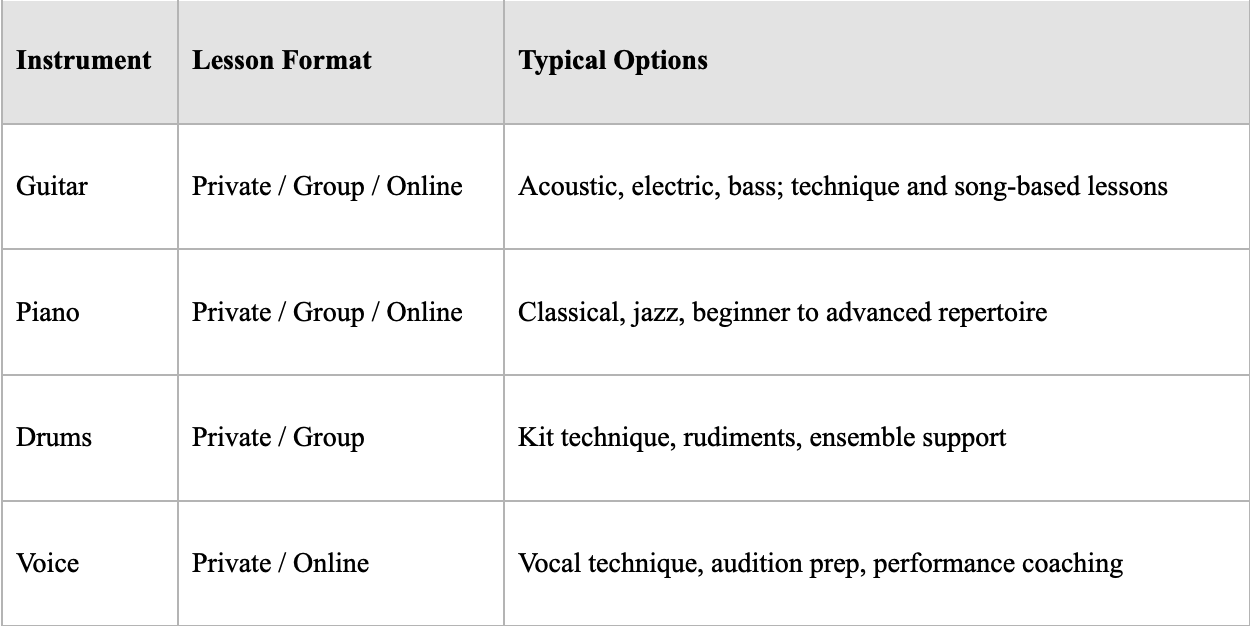
Local offerings emphasize practical skills, repertoire development, and ensemble experience, which together help learners progress toward recitals and community performances. Below are the common instruments and structural options available regionally, followed by a quick comparison table to scan formats.
Which Instruments Can You Learn Locally?
Guitar (acoustic, electric, bass) is widely taught across age groups and genres.
Piano lessons include classical foundations and contemporary/pop approaches for teens and adults.
Drums and percussion lessons cover basic coordination, kit technique, and ensemble skills.
Voice lessons focus on healthy technique, repertoire, and performance coaching.
Strings (violin) and folk instruments (ukulele, mandolin, banjo) are common in community programs.
These instrument options map to private lessons, group classes, and online formats, making it feasible to find a pathway that fits a learner’s goals and schedule.
Introductory table: compare popular lesson types and formats for quick scanning. This compact comparison helps you match an instrument to the lesson format that best supports practice and performance goals.
What Age Groups and Skill Levels Are Served?
Providers across Central Kentucky design programs for early childhood, school-age children, teens, and adults, with curricula adapted for skill level and age-appropriate goals. Early-childhood and toddler music classes emphasize rhythm, listening, and social interaction through play-based activities that prepare children for later private instruction.
School-age and teen programs balance technique, music reading, and ensemble participation to support school band/orchestra pathways and recital readiness. Adult beginners typically find flexible scheduling and song-based curricula, while intermediate and advanced students often receive performance coaching or college-preparatory guidance. When evaluating options, consider progression plans and opportunities for recitals or ensemble work as part of long-term learning.
Where Can You Find Music Lessons in Key Central Kentucky Cities?
Finding local lessons starts with knowing common local hubs: city music schools, private studios, community programs, university-affiliated offerings, and music retail lesson programs.
Search strategies include checking city arts pages, community center calendars, music store bulletin boards, and university department event listings; local listings and “near me” searches typically surface multiple options to compare.
Typical provider patterns vary by city, and the quick table below shows common provider types and offerings you can expect in key towns.
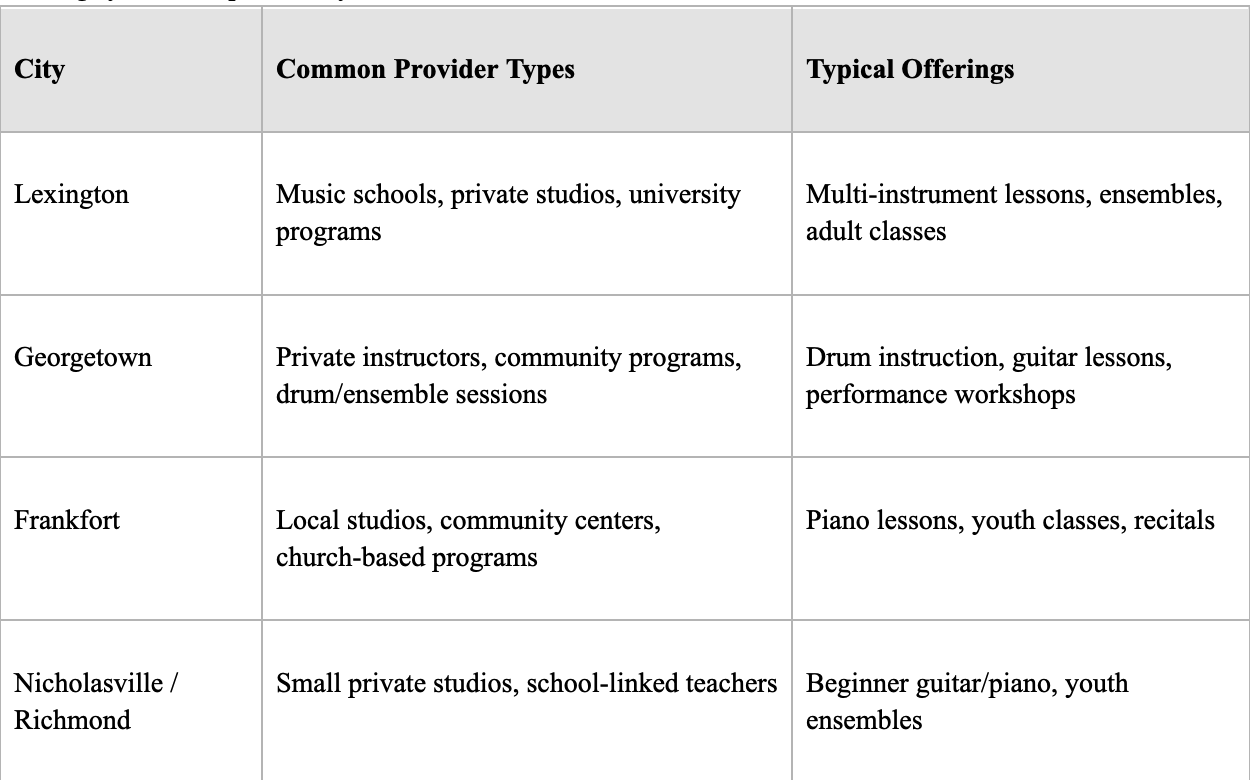
This city-wise snapshot clarifies where different lesson models typically appear so you can target searches by location and format.
How to Find Guitar Lessons in Lexington and Georgetown?
Guitar searches in Lexington and Georgetown succeed when you combine genre needs with venue types: look for teachers who list acoustic or electric specialization depending on your goals. Music stores and lesson programs often host beginner packages, while private instructors advertise experience in specific styles such as folk, rock, or classical guitar.
When contacting potential teachers, ask about repertoire, progression plans, and performance opportunities to ensure style alignment. Local examples of provider types in the region include community schools and dedicated drum or guitar session offerings that regularly post workshops and beginner series.
Where to Take Piano Lessons in GEORGETOWN & Surrounding Areas?
Piano instruction in Georgetown and nearby towns usually appears in private studios, community music programs, and occasional church-based or school-linked classes; formats range from foundational classical studies to adaptable adult lessons. Evaluate teachers by asking about curriculum structure, trial lessons, and whether studio recitals or group classes are part of the program. Many learners prefer a short trial lesson to assess teacher-student fit, lesson pacing, and tonal environment (acoustic piano access, quiet practice space). Local piano study often ties into school music programs and community recitals that provide performance goals and motivation.
How Do You Choose the Right Music Instructor or School in Central Kentucky?
Choosing an instructor or school involves assessing credentials, teaching style, and logistics to match a student’s goals; this checklist gives a clear decision sequence to follow. Look for instructors who balance formal credentials with teaching experience and demonstrated success helping students progress. Teaching styles range from structured, method-based curricula to song-based or repertoire-first approaches; matching the style to a student’s motivation (performance, hobby, therapy-informed goals) is critical. Practical logistics—price, scheduling options, lesson length, and online vs. in-person availability—determine sustainable commitment and consistent progress.
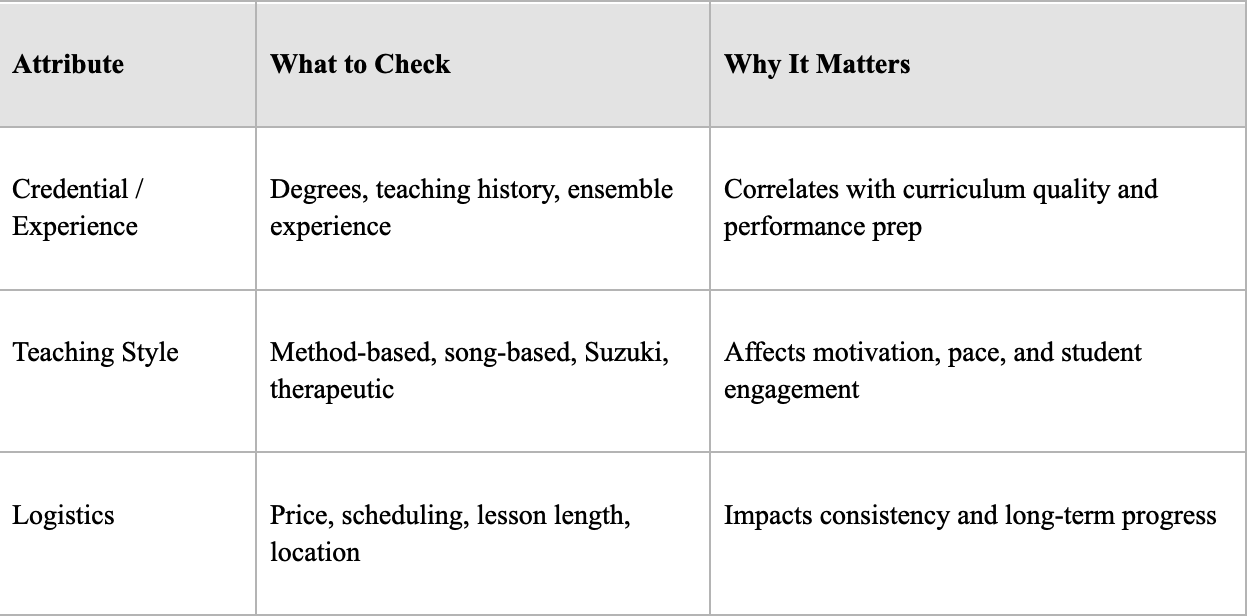
This matrix helps prioritize the attributes that most influence learning outcomes and lesson satisfaction.
What Qualifications and Teaching Styles Should You Look For?
Effective instructors typically combine pedagogical knowledge with practical performance experience; useful qualifications include music degrees, ensemble leadership, or affiliations with educational organizations. Equally important is a teacher’s demonstrated ability to communicate, set realistic goals, and adapt lesson plans to a student’s learning pace; these traits often matter more than any single credential.
Teaching styles range from classical, technique-focused instruction to contemporary, song-driven lessons and music therapy–informed approaches; choose a style that aligns with the student’s goals to sustain motivation and measurable progress. Ask for references, sample lesson plans, or a brief trial to confirm the match.
How Does Lesson Format Affect Your Learning: In-Person vs. Online?
Lesson format influences sound quality, immediacy of feedback, and access to teachers—each format offers trade-offs that affect learning. In-person lessons are preferable for ensemble skills, instrument access (acoustic piano or drum kits), and tactile technique correction, while online lessons increase teacher options and scheduling flexibility for students across Central Kentucky.
To succeed online, ensure stable internet, good microphone/room acoustics, and pre-lesson materials for efficient use of time; many teachers combine online check-ins with occasional in-person assessments. Choosing a format depends on goals: performance and ensemble readiness favor in-person work, while convenience and broader stylistic access often point to online instruction.
What Are the Benefits of Taking Music Lessons in Georgetown Kentucky?
Taking lessons locally combines cognitive, social, and community advantages: instruction improves memory and attention, builds teamwork skills through ensembles, and creates performance pathways via recitals and festivals. Music study supports academic skills like reading and pattern recognition while promoting discipline and time management that transfer to school and work. Community-based opportunities—youth ensembles, open mic nights, church choirs, and school concerts—give students regular milestones to showcase progress and develop confidence. Below are core benefits summarized for quick reference.
Cognitive Gains: Music training strengthens memory, auditory processing, and executive function.
Social Development: Ensemble participation builds teamwork, communication, and self-confidence.
Community Access: Local recitals, festivals, and ensembles provide performance experience and social networks.
These benefits translate into measurable growth for learners and multiple avenues to stay engaged in music over time; search local listings or contact community music programs to find upcoming opportunities.
How Do Music Lessons Improve Cognitive and Social Skills?
Music lessons enhance memory and attention by training working memory, auditory discrimination, and pattern recognition—skills linked to reading and math development. Regular practice promotes discipline and goal-setting, which support executive function and sustained concentration in classroom and workplace settings. Socially, lessons that include ensemble or group classes foster communication, turn-taking, and collaborative problem-solving, all of which contribute to greater self-confidence and community belonging. Recent studies and contemporary pedagogical perspectives indicate that consistent, structured music instruction yields both cognitive and emotional benefits across ages.
What Performance and Community Opportunities Are Available?
Students who study in Central Kentucky can expect access to studio recitals, community ensembles, school concerts, and seasonal festivals that provide regular performance goals. Many community programs and music schools host open-mic events and collaborative workshops, which are ideal for building stage experience and peer networks.
Participation in ensembles and public performances reinforces practice habits and connects learners with teachers, accompanists, and local arts organizers who help sustain long-term musical growth. To get involved, ask teachers about recital schedules, community ensemble auditions, and local festival submissions.